

Adult ADHD Therapy + Coaching
Online support for adults navigating ADHD in everyday life.
Adult ADHD often goes unnoticed, especially when you’ve spent your entire life trying to keep up.
You may be here because:
→ Starting tasks has always felt harder than it should, especially if they feel boring, vague, or overwhelming
→ You move between periods of intense focus and distraction, sometimes losing hours without meaning to
→ Your sense of time can feel unreliable — it slips away, or things take much longer than expected
→ Emotional responses have always been stronger, harder to predict, or harder to regulate than you’d like
→ You’ve learned how to get by, but it takes constant effort, and you may quietly wonder why it feels so much harder for you than it seems to be for others.

These experiences are not a personal failing or a lack of willpower.
But a reflection how an ADHD nervous system tries to operate in a world that was not designed with it in mind.
Support Tailored for You
The right kind of care does not pathologize your nervous system or reduce your experience to a checklist.
We start with this: you aren’t broken.
Many of the struggles you live with are understandable, adaptive responses to long-standing demands, expectations, and environments that were never designed with an ADHD brain in mind. Therapy helps make sense of those patterns—not to judge them, but to understand how they developed and how they’re currently affecting your life. From there, we focus on building ways of living that feel more sustainable.
A central part of this work is learning how your ADHD brain actually works.
As you understand ADHD as a difference in attention, motivation, regulation, and executive functioning—rather than a lack thereof or some personal flaw—shame often subsides. When challenges are framed as a mismatch between your nervous system and your environment, self-blame becomes less compelling, and self-trust has more room to grow.

Together we might:
-
We look at how your attention, energy, and regulation show up across relationships, work, and daily life—not to fix you, but to notice patterns. Understanding where friction happens helps us reduce it, rather than asking you to push through it.
-
We explore how motivation, attention, and executive functioning actually operate for you. As this understanding grows, change comes from alignment—working with your brain’s patterns instead of constantly correcting yourself.
-
Many strategies you rely on made sense at the time. We slow down to understand what those adaptations protected you from, and where they now create strain or exhaustion, without judgment.
-
Instead of forcing yourself into systems that don’t work, we shape supports around your real life, values, and energy. The goal is less friction, not more effort.
-
Rest and recovery are not rewards for functioning well—they are part of functioning at all. We create space to stop overriding your limits and start listening to them.
Sound like a good fit?
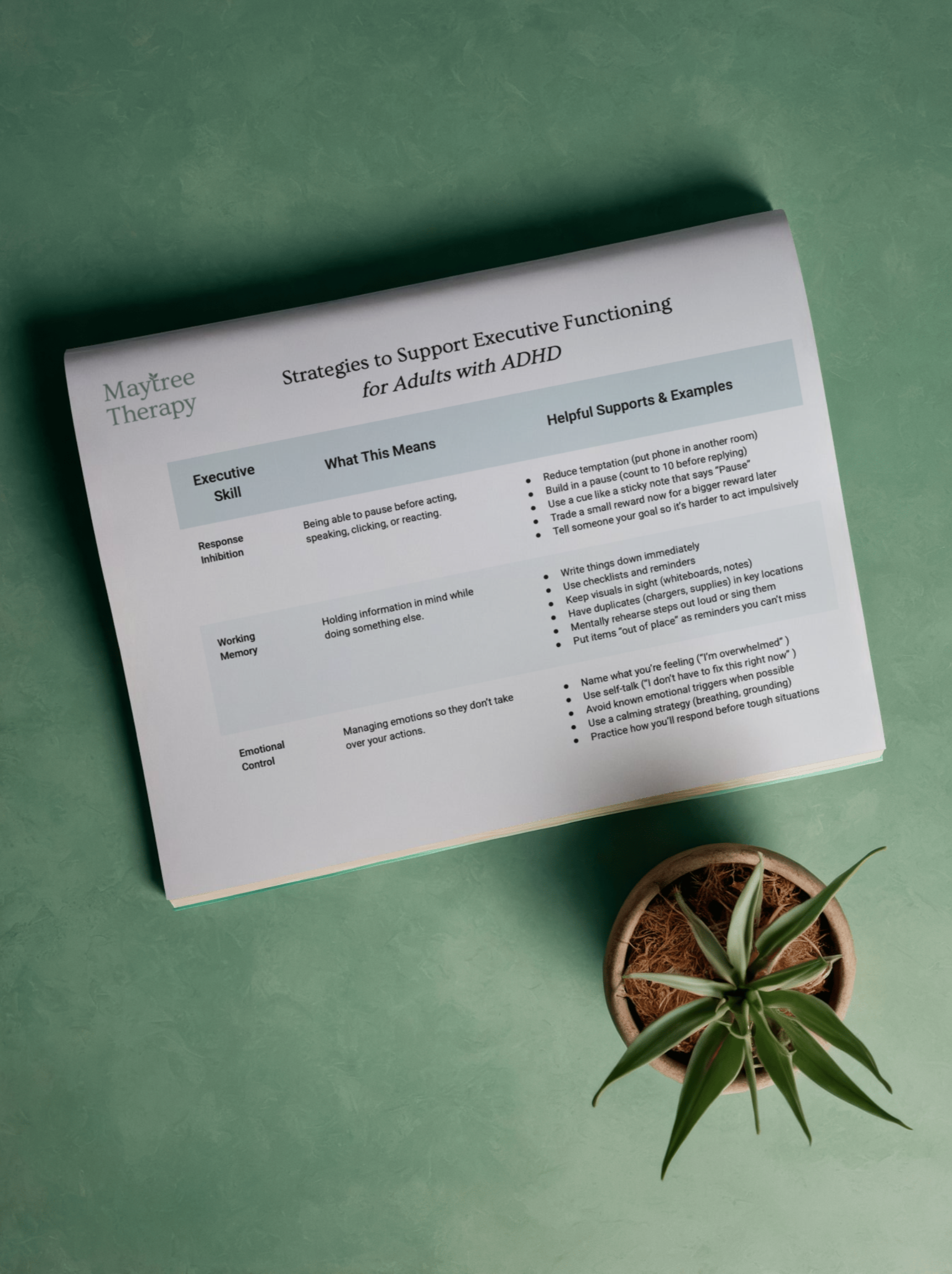
Executive Function Support Strategies
for Adults with ADHD
PDF · 4 pages · Free download
A practical, plain-language guide to executive functioning skills, what they mean, and helpful strategies for each. This handout focuses on external strategies, environmental supports, and realistic tools for adults with ADHD, burnout, or chronic stress.
Deep Thinker
꩜
Curious
꩜
Natural Leader
꩜
Spontaneous
꩜
Assertive
꩜
Creative
꩜
Tenacious
꩜
Passionate
꩜
Advocate
꩜
Energetic
꩜
ADHD
꩜
Deep Thinker ꩜ Curious ꩜ Natural Leader ꩜ Spontaneous ꩜ Assertive ꩜ Creative ꩜ Tenacious ꩜ Passionate ꩜ Advocate ꩜ Energetic ꩜ ADHD ꩜
Your Questions, Answered
-
ADHD-focused therapy attends directly to executive functioning, energy, motivation, and emotional regulation—not just insight or coping. The work is practical, educational, and collaborative, with an emphasis on building supports that fit how your brain actually works.
-
I am qualified to diagnose ADHD. However, I do not offer standalone, formal ADHD assessments for the purpose of establishing a new diagnosis on an individual basis. Best practice for diagnostic clarity typically involves a comprehensive psychological evaluation, including cognitive and performance-based measures and developmental history, which are best conducted by a psychologist with access to the full assessment battery.
Within therapy, I may use validated screening and assessment tools in several situations: to help clients who have already been diagnosed better understand their symptom profile, to explore ongoing questions or seek a second opinion, or to support someone in deciding whether a full psychological evaluation would be useful. My practice is centered on ongoing therapeutic support rather than one-time diagnostic testing.
-
Much of my work is with adults who have already been diagnosed with ADHD and are looking for ongoing support—particularly around executive functioning, emotional regulation, self-trust, and reducing shame and burnout. However, you do not need a diagnosis to begin therapy.
We can use screening tools, psychoeducation, and reflection on your lived experience to clarify what may be going on and whether a formal assessment would be useful. My role is to support you in understanding your options, not to push you toward a diagnosis.
-
This work integrates elements of both, with a strong emphasis on psychoeducation. A central part of my approach is helping clients deeply understand how ADHD affects attention, motivation, emotion, and executive functioning. As someone with ADHD, I’ve seen how learning about my own brain supported clarity, self-acceptance, confidence, and more sustainable change. Sessions may include practical strategies and skills-building, alongside space to process the emotional impact of living with ADHD in a world that often expects something different.
-
No. I do not prescribe medication. That said, I stay informed about ADHD medications as part of responsible clinical practice and can offer general, educational information about how different medications are commonly used, what questions to ask a prescriber, and how medication may interact with therapy. I can collaborate with or refer you to the appropriate professional if needed.

“You might describe many with ADHD as having a ‘special something,’ a hard-to-pin-down yet undeniable potential. If that potential can be tapped, the results can be spectacular.”
- Edward M. Hallowell, MD